
Introduction to NEPRA Net Metering Policy 2026
The NEPRA Net Metering Policy 2026 has been formally amended, bringing clarity after recent reforms sparked debate across the energy sector. The National Electric Power Regulatory Authority (NEPRA) issued a notification confirming that existing solar consumers will continue under their current agreements. This announcement reassures thousands of prosumers who were concerned about the impact of regulatory changes on their solar investments.
The amendment has taken effect from February 9, 2026, and NEPRA has also opened the draft regulations for public consultation. Stakeholders have been given 30 days to submit feedback and suggestions. The proposed amendments to the Prosumer Regulations 2026 are available on NEPRA’s official platform, inviting transparent participation before final approval.
- Amendment effective from February 9, 2026
- Existing agreements remain protected
- Draft regulations open for public feedback
- 30-day consultation period announced
You Can Also Read: Rs. 1500 Prize Bond Draw Number 105 Results Announced in Lahore
Protection for Existing Consumers Under NEPRA Net Metering Policy 2026
A key feature of the NEPRA Net Metering Policy 2026 is the protection of current solar consumers. NEPRA has clearly stated that all approvals, licenses, agreements, and concurrences granted under previous regulations will remain valid until their contractual expiry. This means existing distributed generators will continue to be billed under the earlier rate structure and compensation mechanism.
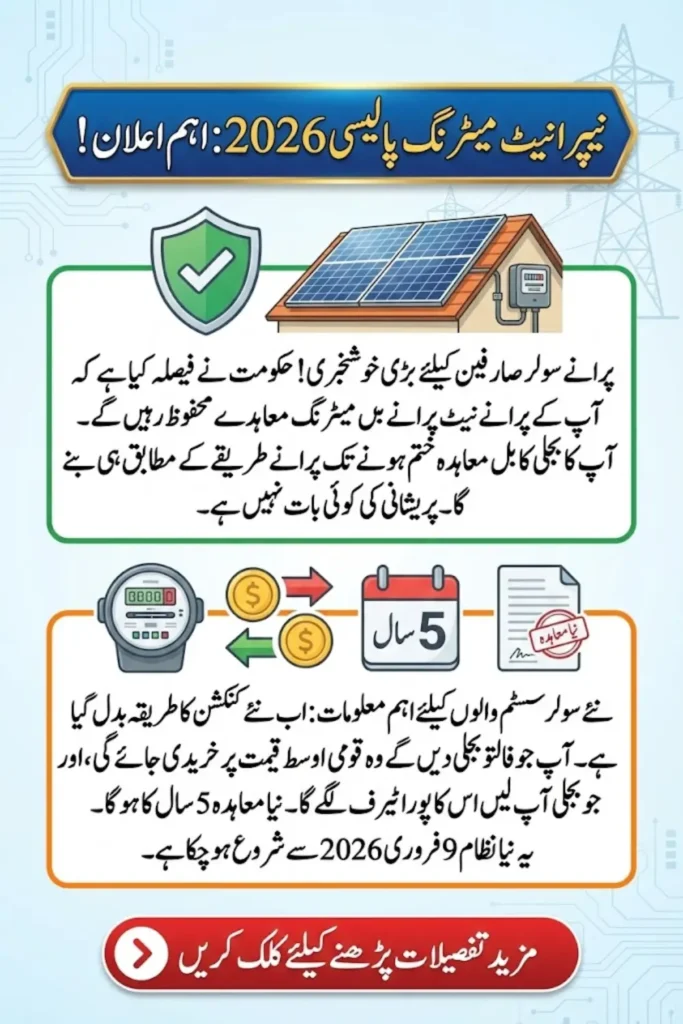
The regulator has ensured legal continuity by maintaining earlier contractual commitments. Consumers who installed solar systems under previous net metering arrangements will not face immediate changes. This safeguard provides stability and prevents disruption to ongoing investments made under the former framework.
- Existing contracts remain valid
- Previous billing rates continue until expiry
- Licenses and approvals remain effective
- Legal continuity maintained for current prosumers
You Can Also Read: Instant Ramadan Relief 2026 – Complete Guide to Rs 10,000 Aid and Helpline 1000 Registration
Major Changes Introduced in NEPRA Net Metering Policy 2026
The NEPRA Net Metering Policy 2026 introduces a significant shift in how surplus electricity is compensated. Under the revised framework, power utilities will purchase excess electricity from prosumers, including households, businesses, and industries generating up to one megawatt, at the national average energy purchase price. This replaces the earlier structure that allowed a direct unit-to-unit adjustment.
Electricity supplied from the grid to prosumers will now be billed at the applicable consumer tariff. The previous one-to-one offset model, where exported units could directly neutralize imported units, has effectively ended. This structural change alters the financial calculation for new solar installations.
- Surplus electricity purchased at national average price
- Grid supply billed at standard consumer tariff
- One-to-one offset model discontinued
- Applies to prosumers up to one megawatt
You Can Also Read: Tiggo 9 Plug-in Hybrid Launched in Pakistan – Premium E-SUV Price, Features, and Performance
Comparison of Old and New Net Metering Framework
| Feature | Previous Model | New Framework |
|---|---|---|
| Compensation Method | One-to-one unit offset | Purchase at average energy price |
| Grid Billing | Offset against exports | Billed at consumer tariff |
| Agreement Term | Seven years | Five years |
| Applicability | Net metering system | Net billing framework |
Reduction in Contract Period Under NEPRA Net Metering Policy 2026
Another major adjustment under the NEPRA Net Metering Policy 2026 is the reduction of the standard agreement term. The contract duration has been shortened from seven years to five years, with the possibility of renewal through mutual consent. This change affects new connections and future renewals.
While existing prosumers will continue under their original contracts until expiry, all new agreements will operate within the five-year net billing framework. This shorter duration significantly impacts long-term return calculations for investors considering new solar installations.
- Agreement term reduced to five years
- Renewable through mutual agreement
- Existing contracts unaffected until expiry
- New connections subject to revised duration
You Can Also Read: Punjab Class 9 and 10 Date Sheet 2026 Announced – Complete Exam Schedule
Billing and Settlement Mechanism Explained
The updated NEPRA Net Metering Policy 2026 also clarifies the settlement procedure for surplus electricity. If the electricity supplied by the prosumer exceeds the electricity consumed from the grid, the excess units will either be adjusted in the following billing cycle or paid out every three months.
This quarterly settlement system introduces a structured and predictable compensation process. Instead of immediate bill neutralization under the old model, prosumers will now experience a separate billing and payment mechanism that distinguishes between energy import and export.
- Excess units adjusted in subsequent bill
- Payments issued every three months
- Clear separation between import and export billing
- Structured net billing system
You Can Also Read: Islamabad Free Public WiFi Project Delayed Despite Completion Deadline
Settlement Process Overview
| Scenario | Outcome Under New Rules |
|---|---|
| Export exceeds import | Adjusted next bill or paid quarterly |
| Import exceeds export | Billed at consumer tariff |
| Equal import and export | Net effect based on purchase price |
Public Consultation and Stakeholder Participation
NEPRA has invited stakeholders to review the draft amendments to the Prosumer Regulations 2026. The document is publicly accessible, and individuals, companies, and industry representatives are encouraged to submit their suggestions within the 30-day consultation window. This participatory approach aims to ensure transparency and balanced policymaking.
By opening the draft for feedback, NEPRA is allowing stakeholders to evaluate the financial, technical, and operational implications of the new framework. Final approval will follow after reviewing the submitted comments, ensuring that public input plays a role in shaping the final regulation.
- Draft available on official website
- 30-day feedback period
- Comments to be submitted to registrar
- Final approval after consultation review
You Can Also Read: Memory Chip Shortage Raises PC Prices as Lenovo Warns of Extended Supply Pressure Through 2026
FAQs
What is the main objective of NEPRA Net Metering Policy 2026?
The policy aims to revise the compensation mechanism for surplus solar electricity while protecting existing consumers’ contracts.
Are existing solar consumers affected by the new regulations?
No, current agreements will remain valid until their contractual expiry under the previous billing system.
What replaces the one-to-one offset model?
Surplus electricity will now be purchased at the national average energy purchase price, while grid supply is billed at consumer tariff rates.
How long is the new contract period under NEPRA Net Metering Policy 2026?
New agreements will have a five-year term, renewable by mutual consent between the prosumer and the utility.
You Can Also Read: Punjab Ramadan School Timings 2026 Announced for Single and Double Shift Schools