
Foreign Investors Repatriate $88.8 Million in December 2025
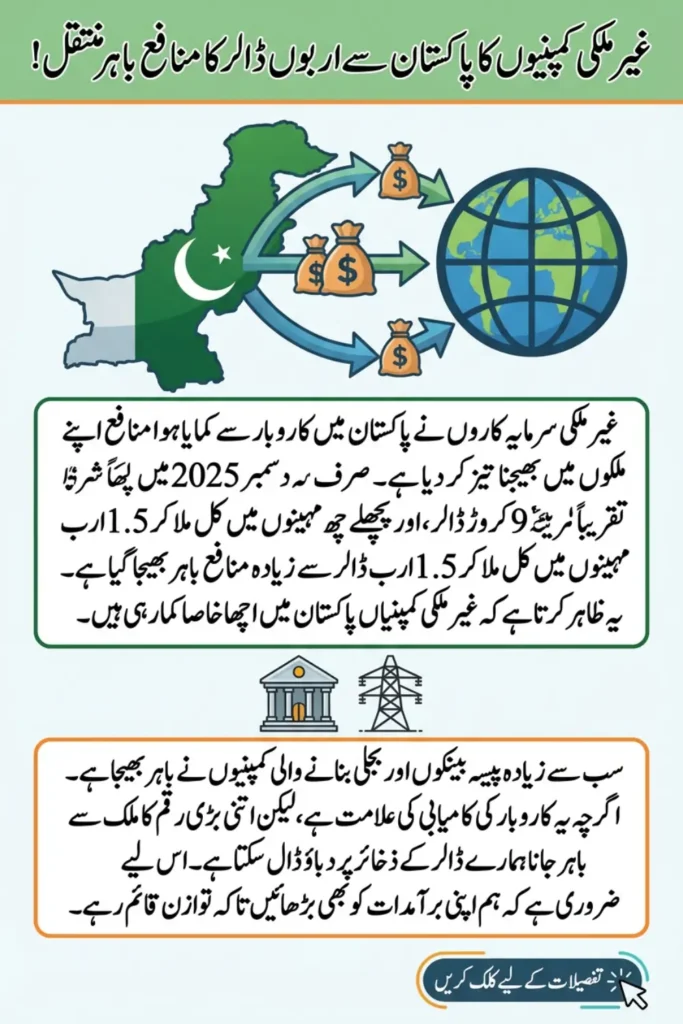
Foreign investors repatriated $88.8 million in December 2025, taking total profit and dividend outflows to $1.51 billion during the first half of FY26. According to data from the State Bank of Pakistan (SBP) and analysis by Arif Habib Limited (AHL), December’s outflows were 3.6 percent higher compared to the same month last year. However, the month-on-month figure dropped sharply by 68.4 percent, following unusually high outflows in November.
Despite this monthly slowdown, cumulative repatriation during July-December FY26 rose by approximately 23 percent year-on-year. This reflects stronger earnings from foreign-owned businesses operating in Pakistan, highlighting their profitability and confidence in the local economy. Analysts note that this trend underscores the importance of managing external accounts carefully, as higher outflows can strain foreign reserves if export growth does not keep pace.
You Can Also Read: Punjab Convenience Markets Expansion: 30 New Tehsil-Level Markets to Provide Jobs for 30,800
Monthly and Yearly Repatriation Trends
December 2025 saw $88.8 million repatriated abroad, including $81 million from Foreign Direct Investment (FDI) returns and $8 million from portfolio investment (FPI) returns. The decline compared to November indicates that previous outflows were unusually high.
Key statistics for FY26 H1 include:
- Total repatriation July–December: $1.51 billion
- December 2025 repatriation: $88.8 million
- Year-on-year increase: ~23%
Analysts believe that smoother foreign exchange transfers and improved business profitability contributed to the rise in repatriation, especially for FDI, which made up 96 percent of total outflows.
You Can Also Read: BISP 8171 Rs. 13500 Payment Via Bank Alfalah ATM Started in 2026 – Complete Withdrawal Guide
Sector-Wise Repatriation Insights
Repatriation is not uniform across sectors. The financial sector led the outflows during FY26 H1, with $368.9 million sent abroad, more than double the $164 million recorded in the same period last year. The power sector followed closely with nearly $359 million in repatriated profits, reflecting improved cash flows and returns on energy-related investments.
Other notable contributors included:
- Food and pharmaceuticals
- Beverages and transport
- Oil and gas exploration
Some sectors, including telecommunications, cement, and oil refining, saw lower repatriation compared to the previous year, indicating mixed performance across industries.
You Can Also Read: Punjab Board Exam Fees Increased Sharply Ahead of 2026 Annual Examinations
Sector-Wise Repatriation Table
| Sector | Repatriated Profits & Dividends (US$ Million) | FY25 H1 Comparison |
|---|---|---|
| Financial | 368.9 | 164 |
| Power | 359 | 300 |
| Communications | 150 | 120 |
| Food & Pharmaceuticals | 120 | 90 |
| Transport & Oil/Gas Exploration | 100 | 85 |
Implications for Pakistan’s External Account
While rising repatriation reflects the profitability of foreign firms, it also adds pressure on Pakistan’s external account. If exports and foreign inflows do not match these outflows, the country may face balance of payments challenges.
Economists suggest that encouraging reinvestment of profits and boosting exports can help balance the external account. At the same time, monitoring sector-wise trends ensures that high-performing industries do not drain foreign reserves excessively.
You Can Also Read: Jazz Network Modernization Sets New Benchmark With 1.2 Tbps and 100 Gbps Deployments in Pakistan
FAQs
Q1: What does foreign profit repatriation mean?
Answer: It refers to profits and dividends earned by foreign investors in Pakistan being transferred back to their home countries.
Q2: Which sectors contributed most to repatriation in FY26 H1?
Answer: The financial and power sectors led repatriation, followed by food, pharmaceuticals, and communications.
Q3: How does repatriation affect Pakistan’s economy?
Answer: High repatriation can put pressure on the external account if export growth and foreign inflows are not sufficient.
Q4: What is the difference between FDI and FPI in repatriation?
Answer: FDI returns, which made up 96 percent of total repatriation, are long-term investments in businesses, while FPI returns are shorter-term portfolio investments.
You Can Also Read: New Customs Values for Used Mobile Phones in Pakistan Announced for 2026