
Punjab 2026 Board Exams for 5th and 8th Grades
The Punjab government’s decision to introduce official board exams for 5th and 8th grades from 2026 marks one of the biggest shifts in the province’s education system in years. This change is meant to raise academic standards, improve learning quality, and ensure that students entering higher grades have strong foundational skills. For teachers, this new system brings a major transformation in classroom planning, teaching style, and assessment techniques. For parents, it brings a clearer understanding of their child’s academic progress and the areas that need support at home.
Punjab 5th & 8th Board Exams 2026
New standardized board exams to strengthen early education
📘 Grades Covered
5th and 8th grade board exams
- Mandatory from 2026
- Applied to all schools
- Uniform assessment system
🏫 Teaching Impact
Shift to structured learning
- Concept-based teaching
- Regular classroom assessments
- Improved lesson planning
👨👩👧 Parents Role
Greater academic involvement
- Clear progress reports
- Home-based revision support
- Regular school coordination
📝 Exam Pattern
Competency-based assessment
- Conceptual questions
- MCQs and short answers
- Reasoning-focused papers
🎓 Teacher Training
Government-led capacity building
- Workshops on paper patterns
- Updated teaching guides
- Continuous performance reviews
✅ Key Benefits
Stronger academic foundations
- Fair and transparent evaluation
- Early weakness identification
- Better future exam readiness
Quick Actions / Key Points
- Start regular study routines early
- Focus on understanding concepts
- Maintain communication with teachers
- Encourage stress-free learning
These changes are not just about conducting exams; they aim to reshape the entire learning environment in government and private schools. Through standardized assessments, improved evaluation methods, and skill-focused curricula, Punjab hopes to build a stronger academic structure for young learners. This guide explains how the 2026 board exams will transform teaching practices, what parents should expect, and how both teachers and families can prepare students for these new educational requirements.
You Can Also Read: Benazir Income Support Programme 2025: Check Eligibility and Latest Disbursement Updates Online
Why did the Punjab Government introduce Board Exams for 5th and 8th Grades?
The decision to start board exams at these levels was made after noticing a decline in learning standards in foundational grades. Officials concluded that students were advancing to higher classes without essential skills.
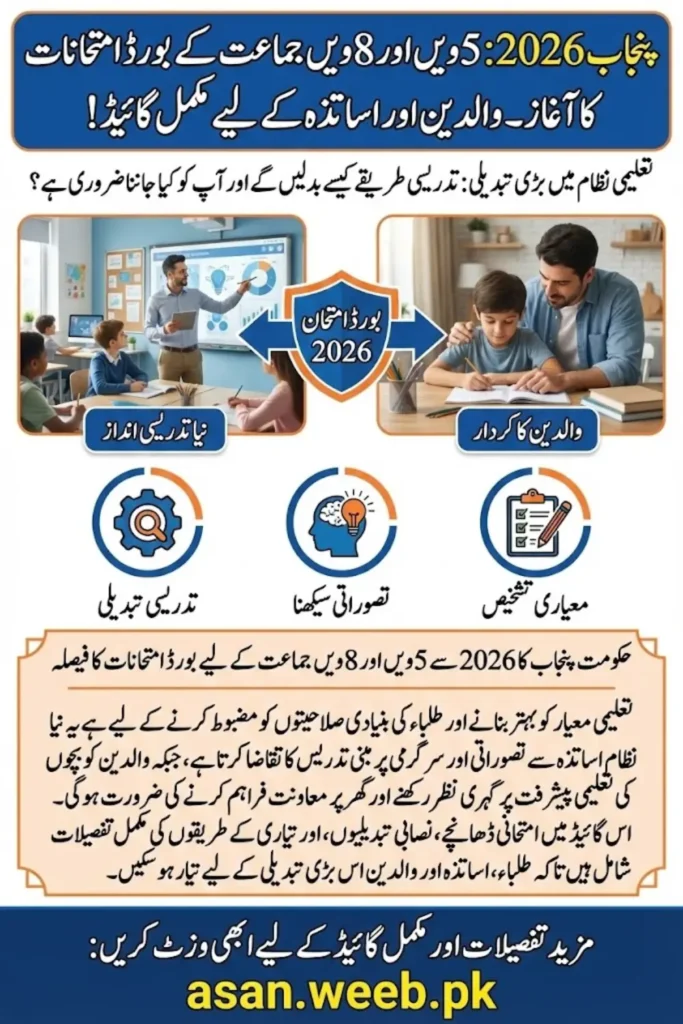
Main Reasons Behind the Policy
- Strengthening early-grade learning outcomes.
- Ensuring students meet minimum learning standards before entering higher grades.
- Identifying weaknesses in teaching practices across schools.
- Creating accountability for both teachers and schools.
- Introducing standardized testing to reduce school-level grading bias.
- Preparing students for future board exams in 9th, 10th, and beyond.
The new policy aims to build a stronger foundation by ensuring students achieve expected learning goals early in their academic journey.
You Can Also Read: Check Your BISP 8171 Payment Privately – A Safe & Secure Verification Guide for 2025
How will these exams impact Classroom Teaching?
The new board exams will significantly influence teaching styles and classroom strategies. Teachers will be required to improve lesson planning and use activity-based learning.
Expected Changes in Teaching Practices
- More focus on conceptual understanding rather than rote memorization.
- Regular assessments and classroom quizzes to track student progress.
- Detailed lesson planning aligned with board syllabus and learning standards.
- Greater emphasis on activity-based and interactive teaching.
- Use of modern teaching tools such as project work, group discussions, and digital aids.
- Continuous teacher training to improve instructional quality.
Teaching will become more structured, organized, and performance-oriented, benefiting both students and educators.
You Can Also Read: Punjab Launches New 8171 BISP Camp Centers – Check Eligibility, Payment Status
What Parents Should Expect from the 2026 Board Exam System
Parents play a key role in preparing children for these exams. The new system will bring more transparency and clearer assessment reports.
Key Changes Parents Will Notice
- Standardized exam papers for all schools under the same board.
- Detailed result cards highlighting strengths and weaknesses.
- Increased communication between the school and parents regarding student progress.
- Need for regular homework support and revision at home.
- More responsibility on parents to ensure punctuality and attendance.
Parents will have clearer insight into their child’s learning level and can provide better support at home.
You Can Also Read: EOBI Login Online by CNIC: Complete Guide to Check Eligibility & Pension Update
How will students need to Adjust Their Study Habits?
With board exams replacing school-level tests, students will need improved discipline and consistency in their studies.
Required Study Habit Adjustments
- Daily revision instead of last-minute preparation.
- Understanding concepts instead of memorizing notes.
- Practicing past papers and sample tests.
- Maintaining notebooks and completing assignments regularly.
- Asking questions in class to clear confusion immediately.
Strong study habits developed at this stage will help students succeed not only in these exams but throughout their academic careers.
You Can Also Read: BISP 8171 Portal: Online CNIC Verification & Registration Check December 2025 Update
New Assessment Style and Paper Pattern for 2026
Punjab’s new assessment model emphasizes competency-based questions. This means learning will be measured through real understanding rather than memory.
Expected Changes in Paper Patterns
- More conceptual questions in science and mathematics.
- Short and long questions designed to test understanding.
- Objective and multiple-choice questions aligned with learning outcomes.
- Scenario-based questions to test reasoning skills.
- Competency-based evaluation rather than book-based testing.
Students will need to focus on learning concepts deeply instead of simply memorizing textbook chapters.
You Can Also Read: Punjab Education Department Confirms Province-Wide Winter Vacation Full Schedule
How Schools Must Prepare for the New Exam Structure?
Schools will have to bring major changes in classroom policies, teacher training programs, and academic calendars.
School-Level Preparations Needed
- Updating the curriculum according to the Punjab examination standards.
- Conducting monthly tests to monitor student performance.
- Setting up training workshops for teachers.
- Ensuring the availability of practice books and sample papers.
- Strengthening monitoring systems for weak subject areas.
Schools must actively support the new exam system to ensure smooth transitions for students and teachers.
You Can Also Read: BISP December 2025 Payment – How to Check Online via 8171.bisp.gov.pk
Training and Support Teachers Will Receive for 2026 Exams
The government plans to provide training programs to help teachers adapt to the new requirements.
Teacher Support Plans
- Workshops on new paper patterns and assessment methods.
- Subject-based training sessions for mathematics, science, and English.
- Classroom management training to improve student engagement.
- Updated teaching guides aligned with learning standards.
- Regular evaluation to ensure teaching quality improves.
Teachers will be better equipped to handle the new system through continuous training and support.
Major Benefits of the New Board Exam Policy
The 2026 board exams aim to improve overall educational quality and produce more capable students for higher grades.
Key Benefits
- Improved learning outcomes across Punjab schools.
- More responsible teaching practices.
- Fair assessment for all students, regardless of school type.
- Early identification of weak areas for timely improvement.
- Better preparation for future board and competitive exams.
The new policy brings long-term educational benefits that will enhance student performance and reduce academic gaps.
You Can Also Read: Alert: Fake 8171 CNIC Check Websites Exposed – December 2025 Scam Warning
Possible Challenges Students, Parents, and Teachers May Face
Although the new system has many advantages, challenges are expected during the transition.
Common Challenges
- Increased pressure on students due to standardized exams.
- Teachers require time to adjust to new teaching guidelines.
- Parents need to provide more academic support at home.
- Schools need financial resources for updated materials.
- Difficulty for slow learners to adjust quickly.
With proper planning and support, these challenges can be minimized, ensuring smooth implementation.
You Can Also Read: BISP 8171 Digital Wallet 2025 – Check Your Rs. 13,500 December Payment Disbursement Update
Tips for Parents to Help Children Prepare for the Exams
Parents can play a vital role in helping children adjust to the new system through routine support and motivation.
Helpful Tips for Parents
- Monitor your child’s homework daily.
- Encourage them to revise lessons regularly.
- Avoid pressuring them; instead, motivate gently.
- Create a quiet environment for study at home.
- Communicate with teachers to understand progress.
Active parental involvement can significantly improve student performance in the new board exams.
You Can Also Read: How to Verify BISP 8171 PKR 13,500 Payment Online – Complete Web Portal Guide for Pakistan
Tips for Teachers to Improve Classroom Learning
Teachers will need to adopt updated teaching styles to match the new assessment model.
Teaching Tips for Better Learning Results
- Use real-life examples to explain difficult topics.
- Include group work and discussions for active learning.
- Conduct small weekly quizzes for revision.
- Provide feedback to students regularly.
- Use visual aids and modern teaching tools.
Effective teaching strategies can help students perform better and reduce exam stress.
You Can Also Read: Benazir Income Support Programme 2025: Check Eligibility and Latest Disbursement
Conclusion
The Punjab 2026 board exams for 5th and 8th grades mark a major transformation in the province’s education system. By focusing on conceptual learning, skill-based assessments, and standardized testing, the government aims to strengthen early education and improve the quality of teaching. These exams will push schools to maintain higher academic standards and encourage teachers to adopt modern and student-centered teaching practices.
For parents, this system offers greater clarity about their child’s academic progress and highlights areas where extra support is needed. For teachers, it brings an opportunity to improve classroom techniques and raise the quality of learning. With proper coordination between parents, teachers, and schools, students can adapt to the new system smoothly and benefit from stronger foundations that will support them throughout their educational journey.
You Can Also Read: Check Your BISP 8171 Payment Privately – A Safe & Secure Verification Guide for 2025
Frequently Asked Questions
Will all schools in Punjab follow the new board exam system?
Yes, both government and private schools must follow the standardized 5th and 8th grade board exams from 2026.
Will the paper pattern be the same for every school?
Yes, the paper pattern will be uniform to ensure fair assessment across the province.
How early should students start preparing?
Students should begin consistent preparation from the beginning of the academic year to avoid stress.
Will slow learners struggle with the new system?
Some may face difficulties initially, but with teacher and parent support, they can adjust successfully.
Are these exams similar to 9th and 10th board exams?
They follow a similar structure but are easier and designed to test foundational skills.
You Can Also Read: Punjab Launches New 8171 BISP Camp Centers – Check Eligibility