Introduction to Maryam Nawaz Mianwali Development Plan
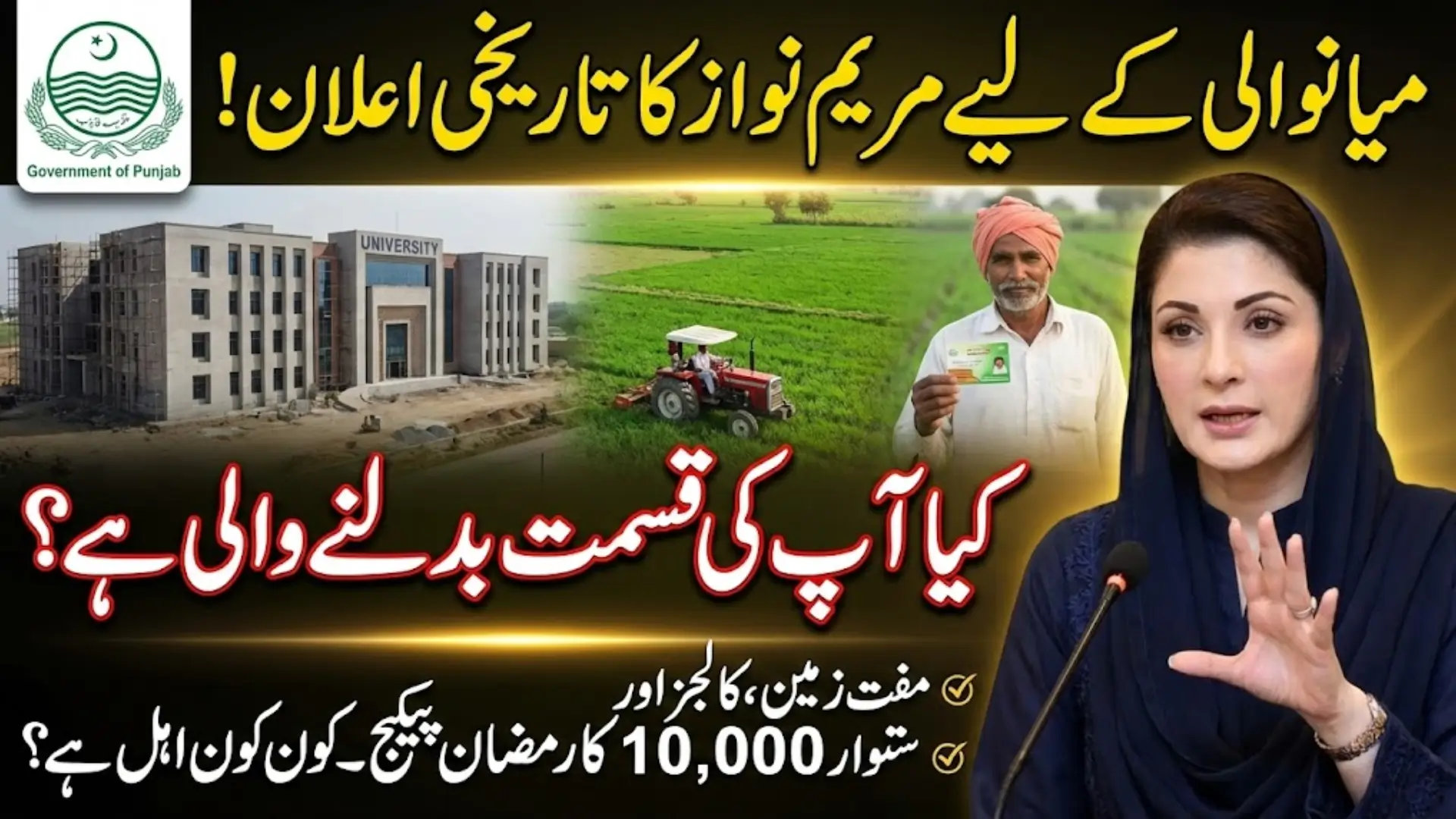
The Maryam Nawaz Mianwali Development Plan marks a significant step toward expanding education and strengthening agriculture in Punjab. Punjab Chief Minister Maryam Nawaz announced the establishment of medical, law, and agriculture colleges in Mianwali to improve access to higher education. This initiative is designed to reduce educational gaps in remote districts and create new opportunities for local students.
During her public address, she emphasized that regional development is a priority of the provincial government. The plan focuses on education, agriculture, and social welfare to promote balanced growth across Punjab. By investing in institutions and farmer support programs, the government aims to encourage economic progress and long-term stability in underserved areas.
Key focus areas of the development plan include:
- Establishment of professional colleges in Mianwali
- Launch of Apna Khet Apna Rozgar programme
- Continued support for farmers through tractor distribution
- Financial relief for citizens during Ramadan
You Can Also Read: Benazir Income Support Programme: Step-by-Step System to Resolve Stipend Deduction Complaints
Establishment of Medical, Law, and Agriculture Colleges in Mianwali
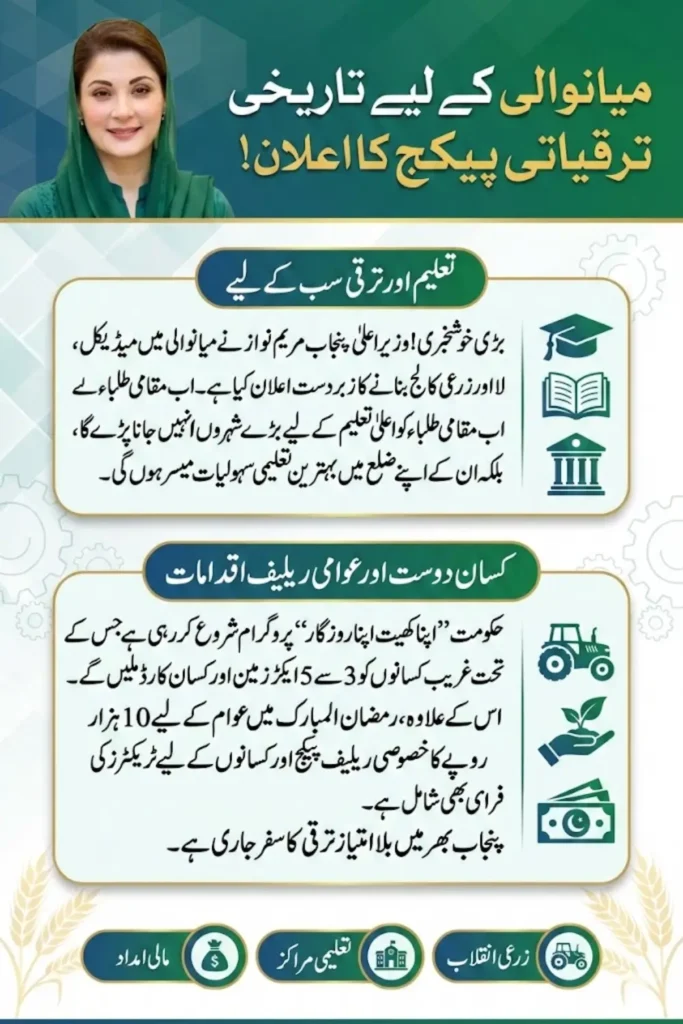
Under the Maryam Nawaz Mianwali Development Plan, new medical, law, and agriculture colleges will be established in Mianwali. These institutions are intended to provide students with professional education within their own district, reducing the need to move to larger cities. Local access to quality education can improve enrollment rates and strengthen the region’s academic environment.
The creation of these colleges will also contribute to local employment and infrastructure development. Educational institutions attract faculty, staff, and related services, which stimulate economic activity. Over time, this move is expected to improve literacy, professional skills, and overall social development in the district.
Expected benefits include:
- Increased access to professional education
- Reduced financial burden on families
- Growth in local academic infrastructure
- New job opportunities in education sector
You Can Also Read: 100000 Free Houses Through Apni Chhat Apna Ghar Scheme Update
Launch of Apna Khet Apna Rozgar Programme
Another major component of the Maryam Nawaz Mianwali Development Plan is the launch of the Apna Khet Apna Rozgar programme. According to the announcement, the programme will begin next week and will provide poor farmers with three to five acres of land. This step aims to support self-employment and encourage agricultural productivity.
In addition to land distribution, eligible farmers will receive Kisan Cards to facilitate farming activities. The programme is designed to help small farmers generate stable income and improve their living standards. By combining land allocation with financial and operational support, the government seeks to promote sustainable rural development.
Main features of the programme:
- Allocation of 3 to 5 acres of land
- Issuance of Kisan Cards
- Focus on poor and landless farmers
- Promotion of agricultural self-employment
You Can Also Read: PM Laptop Scheme 2026 Expanded to Another Province Merit List Announced
Government Support for Farmers and Agriculture
The chief minister highlighted that over 21,000 tractors have been distributed among farmers during the past two years. This effort demonstrates the government’s commitment to strengthening the agriculture sector through practical measures. Access to machinery helps farmers increase efficiency and reduce reliance on manual labor.
Mechanization plays a vital role in modern farming. By supporting farmers with tractors and other initiatives, the government is working to increase crop yields and enhance productivity. These measures also help reduce production costs and improve long-term agricultural sustainability in Punjab.
Agricultural support initiatives include:
- Distribution of more than 21,000 tractors
- Promotion of modern farming techniques
- Strengthening rural economy
- Encouraging higher agricultural output
You Can Also Read: Benazir Kafalat Program Budget Rise 2026 Brings Hope for Millions of Pakistani Families
Summary of Key Announcements
| Announcement | Details |
|---|---|
| New Colleges in Mianwali | Medical, Law, and Agriculture Colleges |
| Apna Khet Apna Rozgar | 3–5 acres of land for poor farmers |
| Kisan Cards | Provided for farming support |
| Tractor Distribution | Over 21,000 tractors in two years |
| Ramadan Relief | Rs 10,000 for nearly 4 million citizens |
This table summarizes the major initiatives introduced under the Maryam Nawaz Mianwali Development Plan. Each initiative focuses on long-term improvement in education, agriculture, and public welfare.
Ramadan Relief Package for Citizens
As part of the broader welfare agenda, the government has announced a Ramadan relief package that will provide Rs10,000 to nearly four million citizens. This financial support is aimed at helping families manage expenses during the holy month of Ramadan. Rising inflation and living costs have increased financial pressure on many households, making such assistance essential.
The relief package reflects the government’s focus on inclusive development. By targeting vulnerable populations, the initiative seeks to ensure that citizens can meet basic needs during Ramadan. Financial aid programs like this play an important role in maintaining social stability and supporting low-income families.
Relief package highlights:
- Rs10,000 financial assistance
- Nearly 4 million beneficiaries
- Support during Ramadan
- Focus on low-income households
You Can Also Read: Kafalat Program Phase 1 Details In 2026 Of 13500 Payment For Eligible People
Development Across Punjab Without Discrimination
The chief minister also stated that development projects are being carried out across Punjab without discrimination. The government aims to ensure that all districts receive equal attention in terms of infrastructure, education, and welfare projects. Balanced development is considered essential for provincial harmony and economic growth.
By investing in districts like Mianwali, the government seeks to reduce regional disparities. Equal distribution of resources can help create uniform progress and strengthen public trust. The Maryam Nawaz Mianwali Development Plan reflects a broader strategy to promote inclusive governance and sustainable development throughout the province.
Development priorities include:
- Equal resource allocation across districts
- Expansion of infrastructure projects
- Strengthening public services
- Transparent and inclusive governance
You Can Also Read: BISP January 2026 Payment Eligibility Criteria Updated For New 13500 Payments
Frequently Asked Questions
What is included in the Maryam Nawaz Mianwali Development Plan?
The plan includes new medical, law, and agriculture colleges, farmer support programmes, and a Ramadan relief package.
When will Apna Khet Apna Rozgar programme start?
The programme is scheduled to launch next week, providing land and Kisan Cards to eligible farmers.
How many tractors have been distributed to farmers?
Over 21,000 tractors have been distributed during the past two years to strengthen agriculture.
Who will receive the Ramadan relief payment?
Nearly four million citizens will receive Rs10,000 under the announced relief package.
You Can Also Read: BISP Mobile Van For Disabled Person Registration Door To Door 2026
Conclusion
The Maryam Nawaz Mianwali Development Plan highlights a comprehensive approach to regional progress. By establishing new colleges, supporting farmers through land and machinery, and offering financial relief to citizens, the government aims to strengthen education, agriculture, and social welfare simultaneously. These initiatives demonstrate a focus on practical development and a commitment to long-term growth across Punjab.
You Can Also Read: BISP 2026 Policy Update: Women Beneficiaries Can Choose Any SIM Network Nationwide